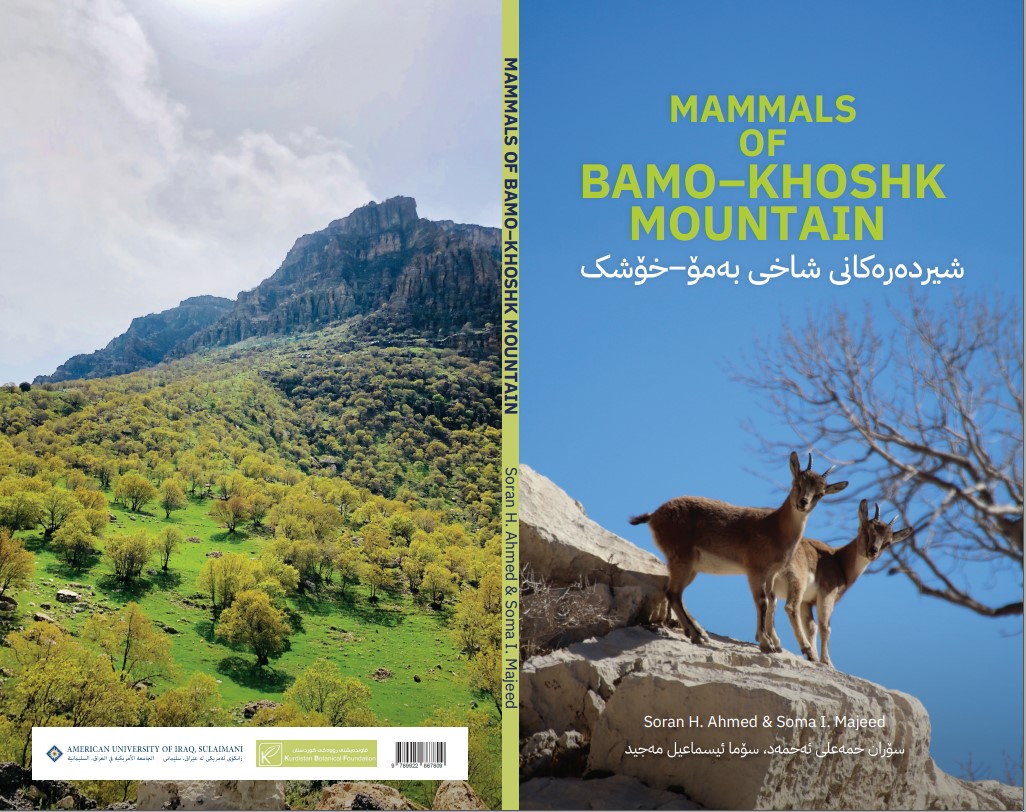
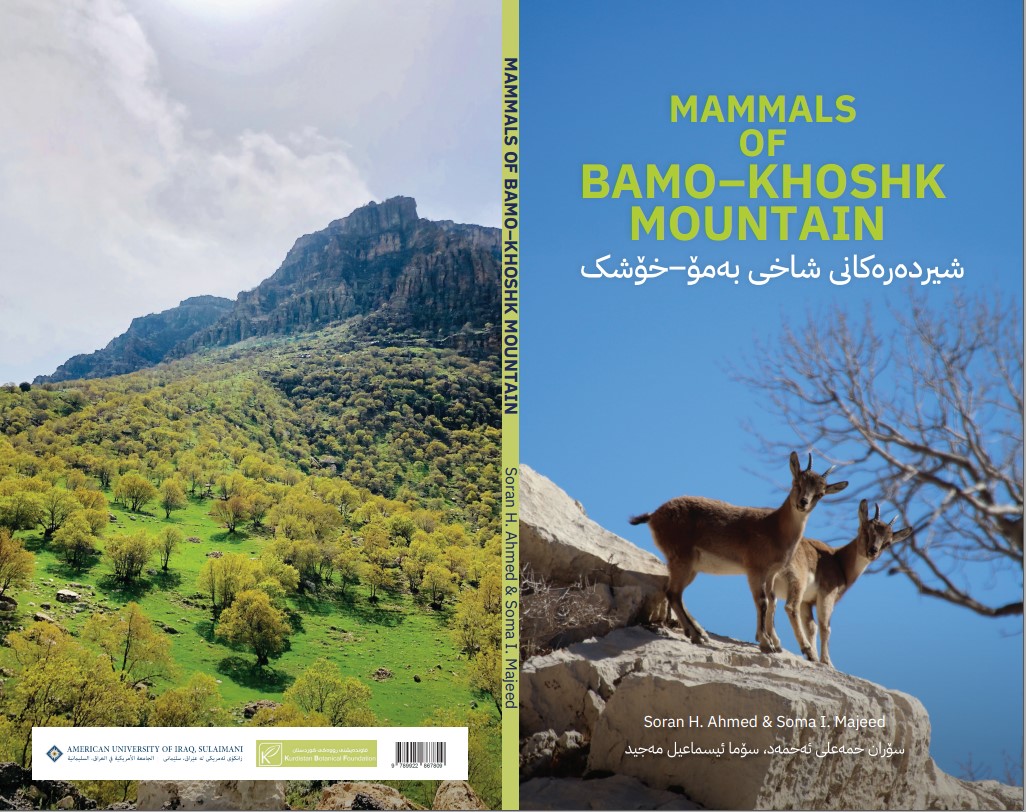
Mammals of Bamo-Khoshk Mountain
Published by: The American University of Iraq, Sulaimani Press, 2026
Authors: Soran H. Ahmed and Soma I. Majeed
ISBN: 9789922900735
Language: Bilingual in English and Kurdish
Bamo–Khoshk Mountain is part of the extensive Zagros Mountains steppe ecoregion and Zagros mixed oak forest. It is located east of Darbandikhan District, between 34.83°–35.05°N and 45.72°–45.81°E. Its altitude ranges from as low as 400 meters above sea level near the Hawasan River to about 1,840 meters above sea level at Tropi Arzhngan, the highest peak of Bamo–Khoshk Mountain. It is a transboundary, mountainous habitat that mainly consists of rocky cliffs and mountain slopes with deciduous mixed oak forest dominated by oak trees Quercus aegilops, Q. brantii, Montpellier maple Acer monspessulanum, pistachio Pistacia euricarpa, P. khinjuk, and hawthorn Crataegus azarolus, followed by steppes and foothills at lower elevations, as well as riparian woodlands mainly dominated by willow Salix spp..
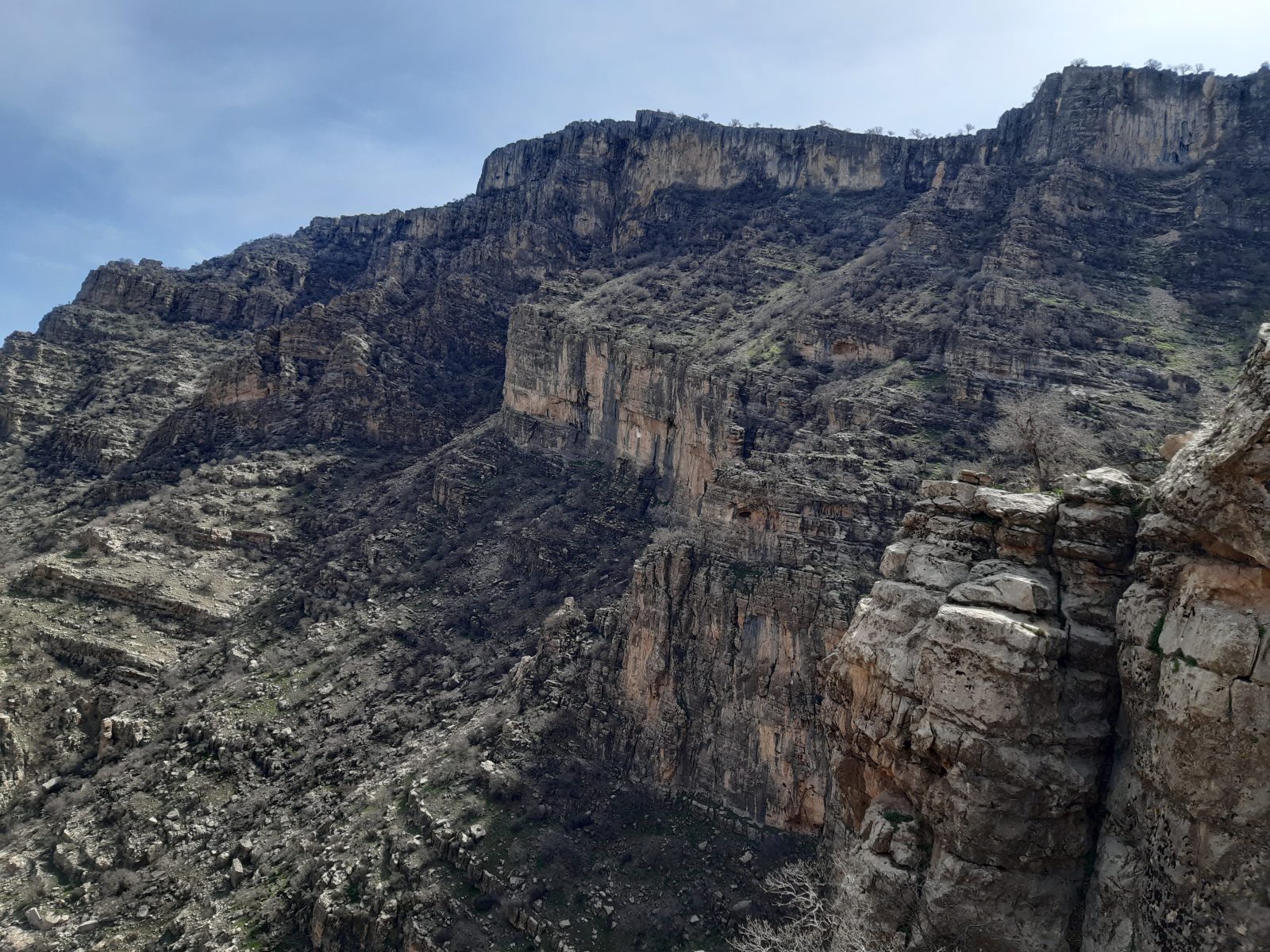
Bamo-Khoshk Mountain general landscape and habitat. Photo: Soran H. Ahmed
This guide is based on seven years of intensive study in the filed, data collection, and camera trapping. For each species account, a short description of key characteristics, habitat, distribution, reproduction, diet, main threats, occurrence, and conservation status is provided. Among the recorded species, one species evaluated by the IUCN as endangered, one as vulnerable, and four as near threatened globally. Recently, on Bamo–Khoshk Mountain, we recorded Blanford’s fox Vulpes cana and Brandt’s hedgehog Paraechinus hypomelas as new species for Iraq (see Ahmed and Al-Sheikhly, 2021; Al-Sheikhly et al., 2024). The honey badger Mellivora capensis and the long–eared hedgehog Hemiechinus auritus were recorded as new species for the Kurdistan Region, with the first mention in this book.
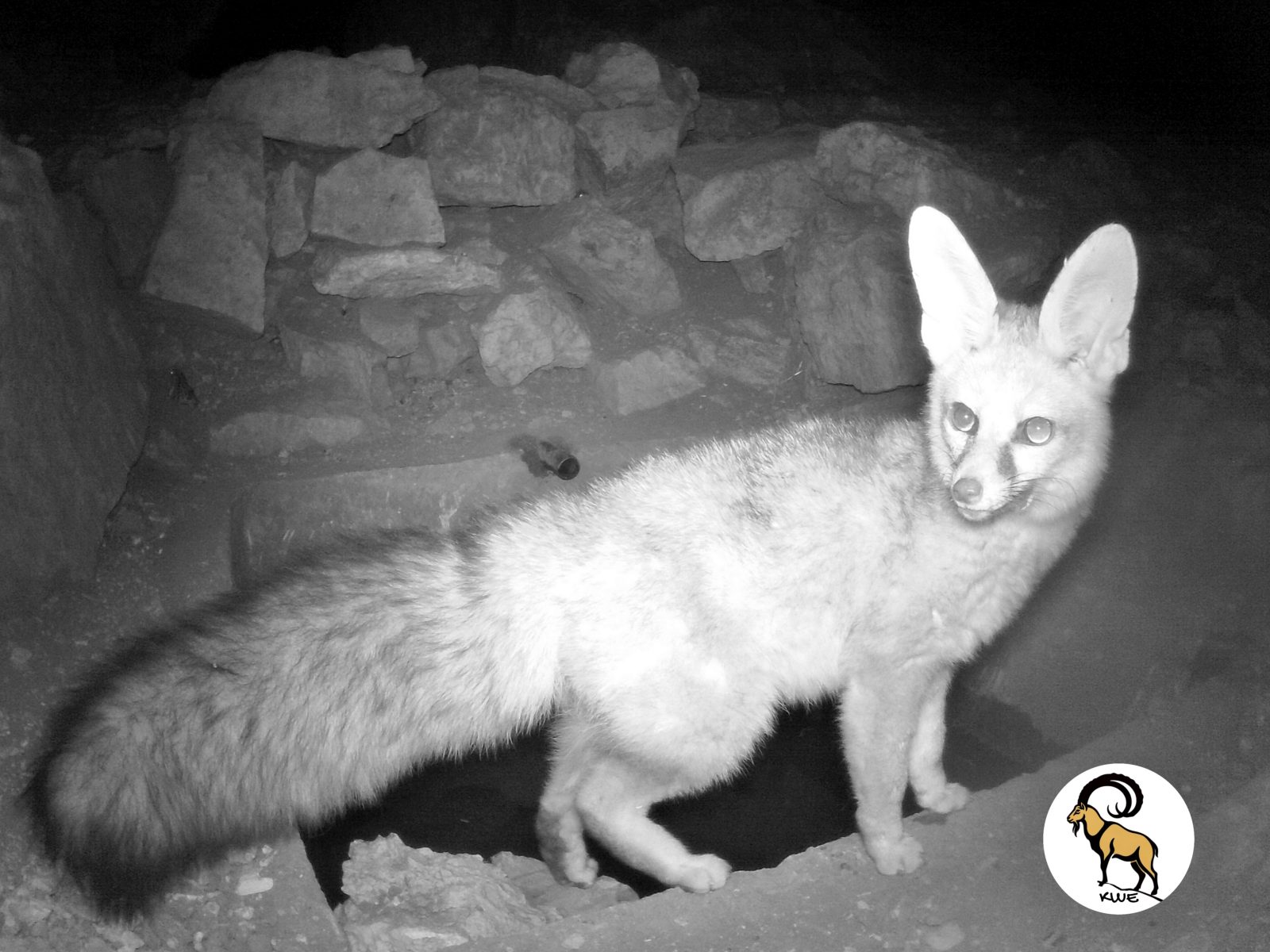
Blanford’s fox Vulpes cana, Bamo-Khoshk Mountain. Photo: Soran H. Ahmed/Soma I. Majeed.
Threats to each individual species are described. Threats to mammalian diversity in the area include poaching and wildlife trafficking, forest fires, minefields, overgrazing, urbanization, habitat loss and fragmentation, and decreasing natural water resources. Conservation plans and environmental management are necessary for the protection of wildlife in the area, such as controlling the main suburban off–roads leading to Bamo–Khoshk Mountain, engaging local communities for conserving biodiversity and raising awareness about the importance of native flora and fauna, activating the forestry police, clearing minefields, controlling forest fires, and ensuring proper water management.
In total, 30 mammalian species were recorded during this study, representing about 50% of the species in the Kurdistan Region and 32% of those in Iraq. Therefore, Bamo–Khoshk Mountain is a biologically diverse area and one of the most remarkable refuges for wildlife in all of Iraq. It is suggested that the study area be designated as a national protected area or a transboundary conservation area between Iraq and Iran.
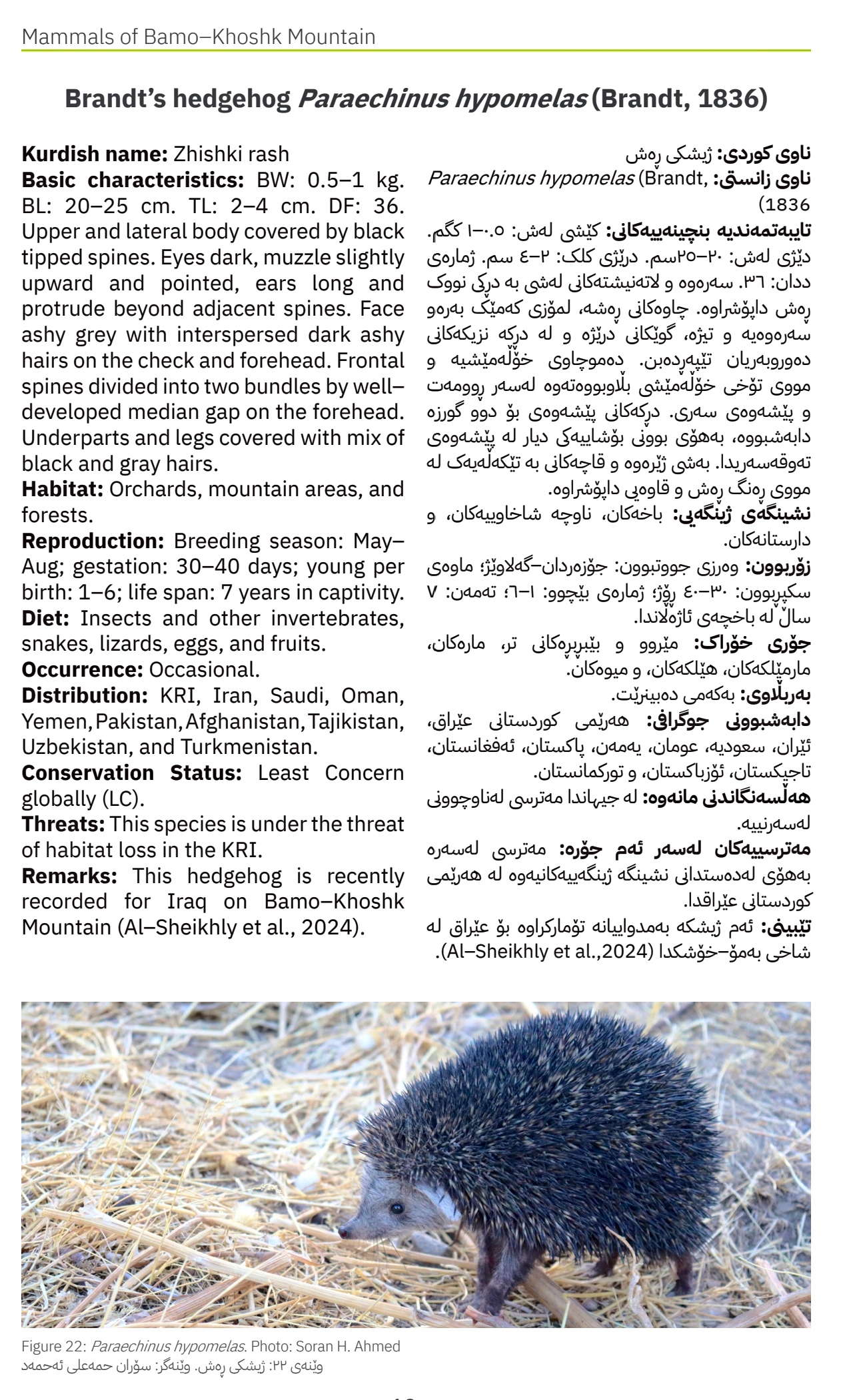
Species account page for Brandt’s hedgehog Paraechinus hypomelas, showing information provided for each species in the book.
Book preface:
Publishing a scientific research on the biodiversity and status of the mammals on Bamo–Khoshk Mountain in 2020 was a starting point to developing an idea about writing this book. Although Bamo–Khoshk Mountain provided a suitable habitat for wildlife, almost nothing was known on the mammalian biodiversity and status before 2020 in the literature. Data on the mammals in the area remained in local stories or unpublished.
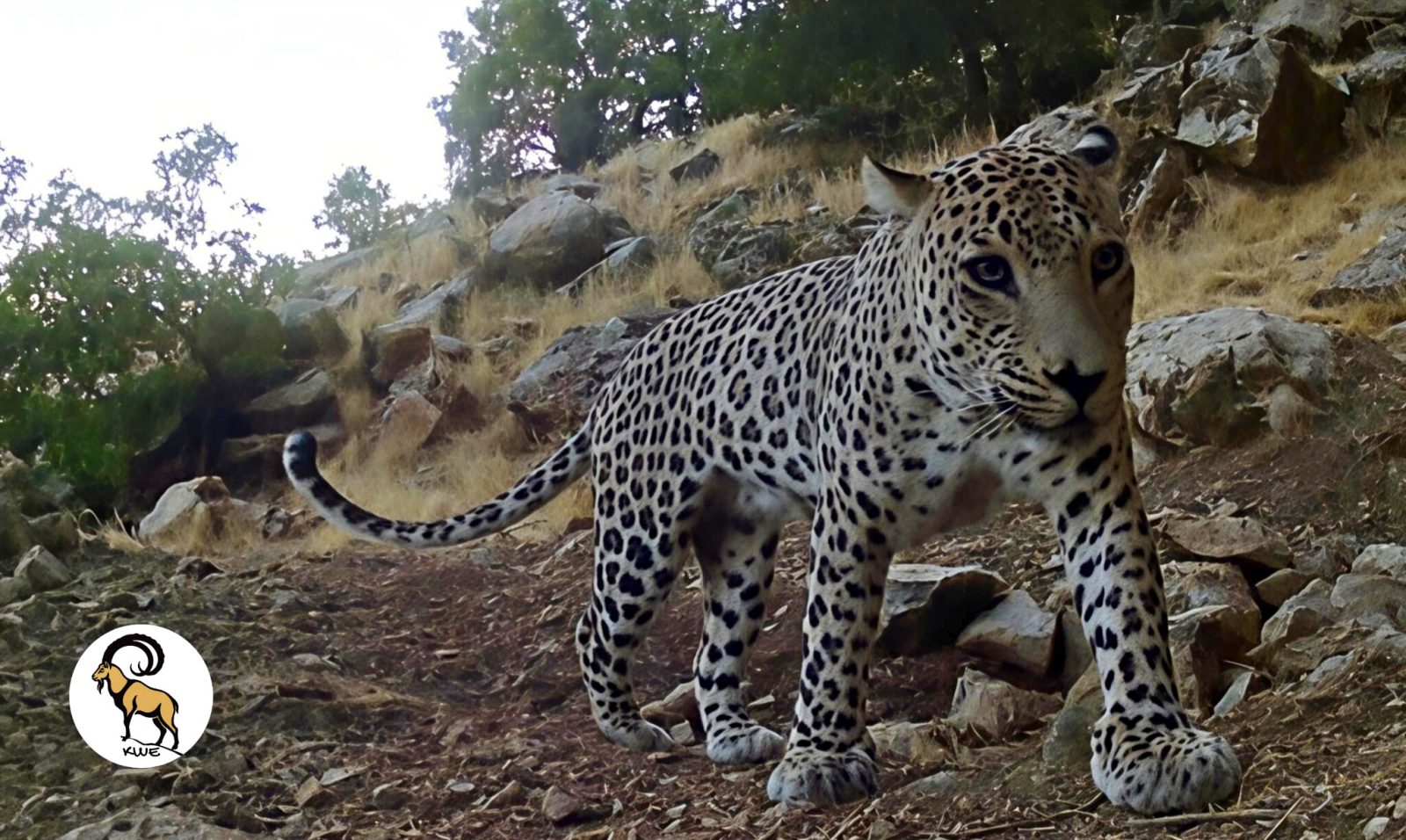
I was born and raised in Kanizhalla village, located between Bamo–Khoshk Mountain. As a child, I had a special connection with the mountains and fascinated by wildlife. Especially at summer nights, I would hear howling sounds and the noise of rocks falling along the slopes. When I asked about these mysterious sounds, my relatives would say, “Some wild animal is roaming the area.” I always wondered which animals might be out there. Besides this, I heard many interesting local stories and narratives about mammals and charismatic species like the Zagrosian leopard. Several stories mentioned sightings of this species and reports of killings. One story my grandmother often narrated, whenever the topic of wildlife and hunting came up, was about my grandfather killing two Zagrosian leopards: one in the 1950s, after a leopard attacked a hunter during hunting by dogs, and another in the 1970s, in response to livestock predation.
The habitat and geography of the area, together with local stories and our own experiences, indicated a rich mammalian biodiversity. However, we felt that this biodiversity was at risk due to various threats, so we decided to begin studying and documenting it scientifically.
Working in mountains like Bamo–Khoshk is challenging and has many limitations, such as rocky terrain, minefields, proximity to borderlines, and lack of financial support. However, our deep connection and passion guided us to complete this book using our time and pocket money. During this journey, we increased the general knowledge of the endangered Zagrosian leopard in the Kurdistan Region of Iraq (KRI) and Iraq, discovered two new mammalian species for Iraq, two new record for the KRI, and produced a comprehensive bilingual English–Kurdish book on the mammals of the area. In April 2017, we set a camera trap on Bamo–Khoshk Mountain as a first step to study the mammals of the area. In 2020, we increased the number of camera traps, and until now, our camera traps have been collecting valuable data.
The primary aim of writing this book is to document the diversity and conservation status of mammals in the Bamo–Khoshk Mountain, making this information available to local people, researchers, and relevant governmental authorities. The second aim is to raise public awareness about mammals in the studied area and the KRI, as this book is the first on wild mammals written in both English and Kurdish. There are few people working in this filed in the KRI, and we hope this book will guide young people to start documenting mammalian biodiversity and improve citizen science data in different areas of the KRI, which is crucial for the conservation of these fascinating creatures in our country. The third aim is to establish a baseline for writing a book on the mammals of the KRI in the future, which we strongly recommend. Mammalian diversity and status in the KRI are not fully explored, and information is sparse in different literatures. To write such a book, intensive systematic filed surveys, citizen science data, and literature reviews are crucial.
Finally, we believe mammals have a special cultural connection with local people, and by studying their diversity, behavior, and ecological roles, we increase our understanding of the natural world and are guided toward implementing feasible conservation practices to ensure this outstanding biodiversity remains for future generations.
Comments (0)
Be the first to comment.